Archive | Features RSS feed for this section

Annual Meeting: A Time to Look Back; A Time to Look Forward

Jump to: Annual Meeting Information | 2014 Proposed Budget

by Fr. John Reeves

Meetings allow us to look back over the past year to count the many ways God has blessed our parish. It is also an opportunity to look forward to new blessings which await us. This year the Annual Meeting will be held November 10 following the Divine Liturgy. It is very important that all members in good standing attend. Ministry reports will be received, the financial state of the parish reviewed and the new budget for 2014 will be presented for adoption.

As well, the proposed revisions to the Parish Bylaws will be put up to a vote for a second time. (You might remember that this action failed last spring because of lack of quorum.) The revisions reflect the changes that the parish have undergone since the bylaws were originally adopted in 1995.

Some of these changes allow for greater flexibility in the duties of Parish Council members and the possibility for an Annual Meeting to expand the number of council positions, if warranted, without needing to change the bylaws.

The amendments would also allow regular business meetings to take place with a quorum of a third of the voting members as opposed to the 50% now required. Encumbering or sale of property would still require the current 50% quorum. (Based on Holy Trinity’s 2014 census of 132 adult members, quorum is now defined as 66 parishioners.)

Other revisions detail the relationship of the Chapel of the Holy Spirit with the parish. These would specifically allow the Chapel:

  • to have both voice and vote on the Council;
  • to vote on specified parish matters by ballot from Snyder County;
  • a mechanism to attain free-standing status as a mission or parish in the future.

As in the past when voting on specific measures, the Annual Meeting will be called to order immediately at the close of the Liturgy. This will enable voting on the Bylaw Revision to begin at the dismissal. All members present and voting at this time will be included as part of the quorum. The results will be canvassed and delivered at the remainder of the meeting, following coffee hour.

Copies of the proposed Parish Bylaws are available in the Narthex along with copies of the proposed budget. Both documents can be accessed online at holytrinity-oca.org.

If you are 18 years of age and fulfilled your Lenten obligation of Confession and Holy Communion in this parish, your presence and your vote are important on Sunday, November 10.

Please make every effort to attend and to vote. Remember, the quorum is 66 adult members.

2013 Annual Meeting Information

Holy Trinity will hold its Annual Meeting on Sunday, November 10 following the Divine Liturgy. Voting on the proposed changes to the Parish Bylaws will begin immediately after the dismissal. Ballots will be tabulated during Coffee Hour before the assembly proceeds with the rest of the agenda.

Any agenda items must be submitted in writing to the Parish Council for review by November 6.

Nothing will be considered from the floor. Nominations are open for Council positions of Secretary, Treasurer, and Vice President—Building.

Parishioners in good standing who were registered with the parish as members at the end of the previous calendar year and who have fulfilled their Lenten obligations of Confession and Communion may and should attend.

Agenda

  1. Opening Prayer: “O Heavenly King…”
  2. Establishment of Quorum
  3. Vote on the Proposed Changes to the Parish Bylaw
  4. Minutes of the 2012 Meeting
  5. Priest’s Report
  6. Treasurer’s Report
  7. Review and Approval of the 2014 Budget
  8. Election of Officers
  9. Closing Prayer: “It is truly meet…”

2014 Proposed Budget

Holy Trinity Income

Category 

2013
YTD* 

2013
Budget 

2014 Proposed 

%
change

Stewardship Offerings

$150,417

$191,682

$207,372

8.2%

Deacon Support Appeal

4,190

5,000

5,000

0.0%

Parking

2,970

3,500

3,500

0.0%

Candles and Flowers

2,617

2,600

2,600

0.0%

OCF Funding Appeal

2,235

2,000

2,500

25.0%

Choir Internship Appeal

860

2,000

1,000

-50.0%

Missions Appeal

500

3,000

1,000

-66.7%

Discretionary Fund

100

500

500

0.0%

Interest Income

338

362

301

-16.9%

Total Income

$164,227

$210,644

$223,773

6.2%

Holy Trinity Expenses

Category 

2013
YTD* 

2013
Budget 

2014
Proposed 

%
change

Personnel

$109,168

$129,721

$134,085

3.4%

Rector’s Stipend/Housing

60,729

72,875

 74,000

1.5%

  Ministry Director’s Stipend/Housing

33,848

40,618

 42,650

5.0%

  Office Assistant

5,472

6,565

 6,565

0.0%

  Custodian

3,969

4,763

 4,900

2.9%

  Continuing Ed.—Rector

2,400

2,400

 1,920

-20.0%

  Continuing Ed.—Deacons

 1,800

  Supply Clergy

1,500

1,250

 1,250

0.0%

  Continuing Ed.—Assistant Priest

1,250

1,250

 1,000

-20.0%

Archdiocese

16,626

20,856

22,116

6.0%

Mortgage

14,430

17,315

17,315

0.0%

Outreach & Fellowship

7,109

8,250

7,750

-6.1%

Liturgical

7,051

6,675

7,675

15.0%

Utilities

4,711

6,535

6,035

-7.7%

Office Administration

3,169

3,850

5,100

32.5%

Physical Plant

2,197

4,050

4,800

18.5%

Christian Education

3,377

3,200

4,100

28.1%

Missionary/Seminaries

2,500

3,000

3,000

0.0%

Coffee Hour

1,538

2,000

2,000

0.0%

Insurance

1,553

1,692

1,777

5.0%

Discretionary Fund

1,228

1,500

1,000

-33.0%

All-American Council

1,000

1,000

1,000

0.0%

Furnishings

1,398

750

750

0.0%

Miscellaneous

109

250

270

8.0%

Transfer to Property Maintenance Fund

5,000

Total Expenses

$177,164

$210,644

$223,773

6.2%

Chapel of the Holy Spirit Income


(Without Building) 

 (With Building)

Category

2013
YTD* 

2013
Budget 

2014
Budget 

%
change 

2014 budget 

%
change

Total Income

$30,566

$32,510

$33,732

3.8%

$33,732

3.8%

Chapel of the Holy Spirit Expenses

(Without Building) 

(With Building) 

Category

2013
YTD*

2013
Budget

2014
Proposed

%
change

2014
Proposed

%
change

Personnel

$11,750

$15,400

$17,200

11.7%

$17,200

11.7%

Pastor’s Housing Allowance***

11,500

13,800

15,000

8.7%

15,000

8.7%

  Deacon’s Housing Allowance

1,200

1,200

  Supply/Visiting Clergy

250

1,000

1,000

0.0%

1,000

0.0%

  Travel Allowance

600

Outreach & Fellowship

932

$1,625

$1,525

-6.2%

$1,625

0.0%

Advertising

294

500

500

0.0%

500

0.0%

  Chapel Events

472

500

500

0.0%

500

0.0%

  Priest’s Discretionary

5

300

300

0.0%

300

0.0%

  Coffee Hour

250

150

-40.0%

250

0.0%

  Website

75

75

0.0%

75

0.0%

  Charity Appeals

161

Property

569

820

690

-15.9%

9,800

1095.1%

Utilities

100

100

0.0%

2,435

2335.0%

Furnishings

542

250

500

100.0%

1,300

420.0%

Liturgical

414

280

575

105.4%

575

105.4%

Office Administration

60

295

150

-49.2%

295

0.0%

Christian Education

200

150

-25.0%

200

0.0%

Archdiocesan/OCA Assessments****

Transfer to Savings

16,299

13,540

12,842

-5.2%

302

-97.8%

Total Expense

$30,566

$32,510

$33,732

3.8%

$33,732

3.8%


* through October 31, 2013
** as presented by the Chapel of the Holy Spirit; to be adopted at the November Parish Council Meeting.
*** Beginning in 2014, the “Pastor’s Housing Allowance” category will include the travel allowance (the “Travel Allowance” category will be eliminated)
**** Holy Trinity subsidizes Archdiocesan/OCA assessments for parishioners who regularly attend the Chapel of the Holy Spirit.

Black Madonna Icon to Visit State College Oct. 23

O2O-North-America-Page-Banner

In the summer of 2012, a group of Catholic and Orthodox faithful began a global pilgrimage in support of life and family under the patronage of the Our Lady of Czestochowa “Black Madonna” Icon. The icon, believed to be one of the seventy icons written by the Apostle and Evangelist Luke, is revered throughout the world.

With the blessing of Metropolitan Tikhon, a magnificent replica of the icon will make an unprecedented visit to State College. On Wednesday, October 23, Holy Trinity will warmly welcome visitors from all faith traditions for an akathist (hymn) sung in honor of the Mother of Jesus Christ for the defense of all human life at 6:30 p.m.; the official icon greeting and viewing begins at 5:30 p.m. After the hymn, a reception will take place for all that attend.

The icon has already traveled more than 40,000 miles and has been revered by hundreds of thousands of people across three continents. The goal of this international icon procession, entitled “Ocean-to-Ocean in Defense for Life,” is to unite Christians in praying for the protection of the family and the sanctification of all human life from conception to natural death. It arrived on the shores of North America in August and will travel across the United States this month and November before continuing on to Central and South America.

The second leg of the pilgrimage is being sponsored by Human Life International (HLI), one of the largest global pro-life organizations in the world. The Rev. Peter West, vice president of HLI Missions, will accompany the icon and be among our honored guests. He was present at the Monastery of Jasna Góra in Poland for the dedication of this icon to the original in January of 2012, which marked the beginning of the campaign.

“This pilgrimage is intended to awaken the faithful about the urgency of defending life from the moment of conception,” said Rev. West. “Hundreds of thousands, in venerating the image, have recommitted to restoring a Culture of Life. I look forward to bringing the icon to State College on October 23.”

The event is free and open to the public. A free-will offering will be collected to support the pilgrimage.

For more information, please contact info@holytrinity-oca.org.

Sabbatical Benefits Continue

by Fr. John Reeves

Fr. John poses with Mka. Linda at the Lewistown train station before departing on his four-month, 27,000-mile pilgrimage in 2010. His route retraced the late 18th-century journey that Orthodox missionary saints took from Finland to Alaska.

Fr. John poses with Mka. Linda at the Lewistown train station before departing on his four-month, 27,000-mile pilgrimage in 2010. His route retraced the late 18th-century journey that Orthodox missionary saints took from Finland to Alaska.

There are several benefits to a sabbatical: Some, such as rest and renewal for a pastor, are more immediate. Other benefits are residual. During my sabbatical three years ago, the parish was charged to develop a more self-reliant model of ministry in my absence. Administrative matters had to be dealt with in the absence of the priest and a working model of collaborative decision-making came into existence during that time.

In the ensuing time, this model has been maintained and expanded. Deacon Alexander Cadman now serves the parish as its full-time ministry coordinator, continuing to hone his skills which were greatly on demand while I had been away. The Parish Council continues to work together as a single unit, furthering our goals and looking forward to our future.

Such harmonious administration in the parish also means that when the priest now takes a vacation, things that need to be done don’t simply get put on hold until he returns. Lay leadership has taken stock of its own responsibilities and continues to press ahead.

Consequently, after three weeks in my Texas homeland—a time spent visiting families, attending reunions, co-officiating at a wedding for a former student in Houston (Jab Tannous), and capped off by a visit to New Orleans en route home (an homage to Matushka’s Cuban and French ancestry)—I could return without dreading a mound of unfinished work or unattended situations.

I could come back, rested and renewed a bit knowing that Vacation Bible School would be wrapping up another successful summer thanks to Deacon Mark and those that volunteered; that we would soon celebrate our parish feast of Pentecost together and go picnic in the park afterwards; and that we could then have the double joy of David Smith’s ordination on the Feast of Ss. Peter and Paul and the wedding of Paul Petrogeorge and Larissa Moser the next day.

In other words, I stopped working during vacation. I rested though it sounds like I was very busy. In short, I relaxed. But the parish did not slow down a bit. That’s a great stress reliever, an ongoing benefit of that sabbatical three years ago which keeps paying dividends even now.

Related: Peruse In the Footsteps of St. Herman, Fr. John’s Sabbatical Blog


Students Sprint to the Finish of a Week Full of Learning, Fun

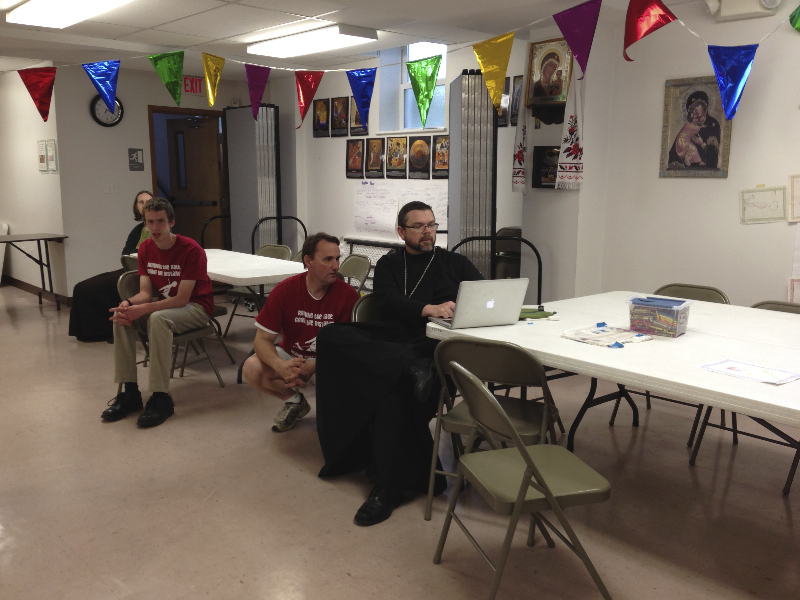
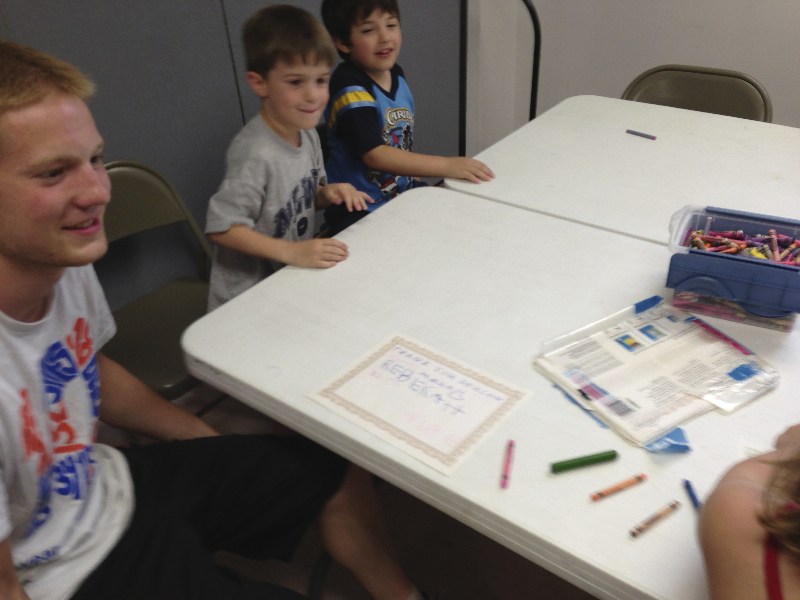
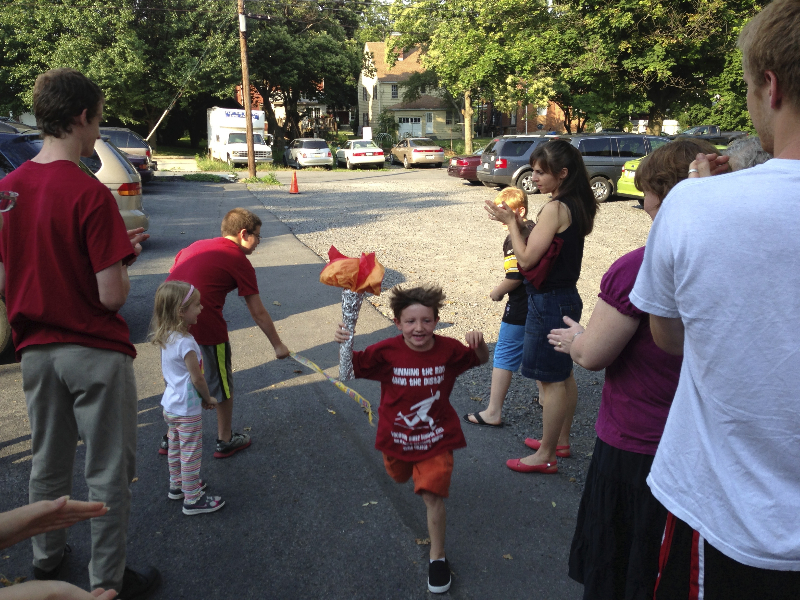
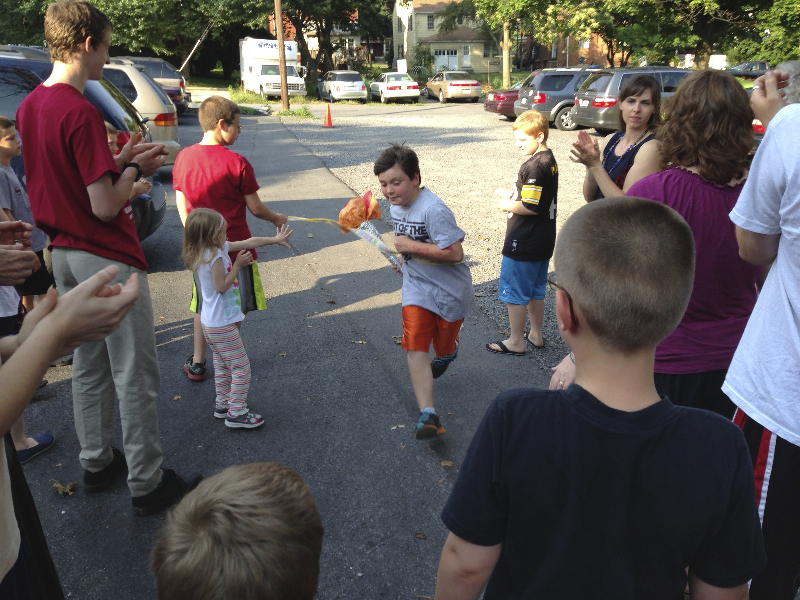
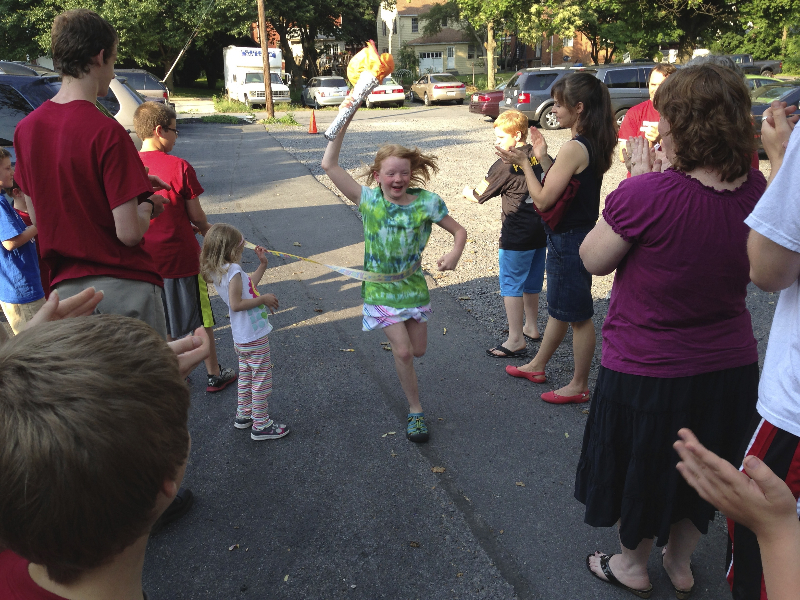
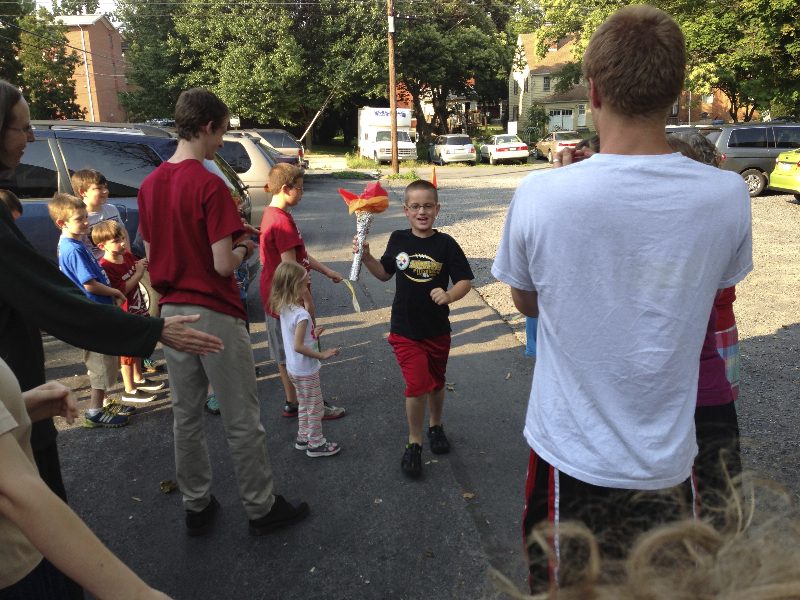
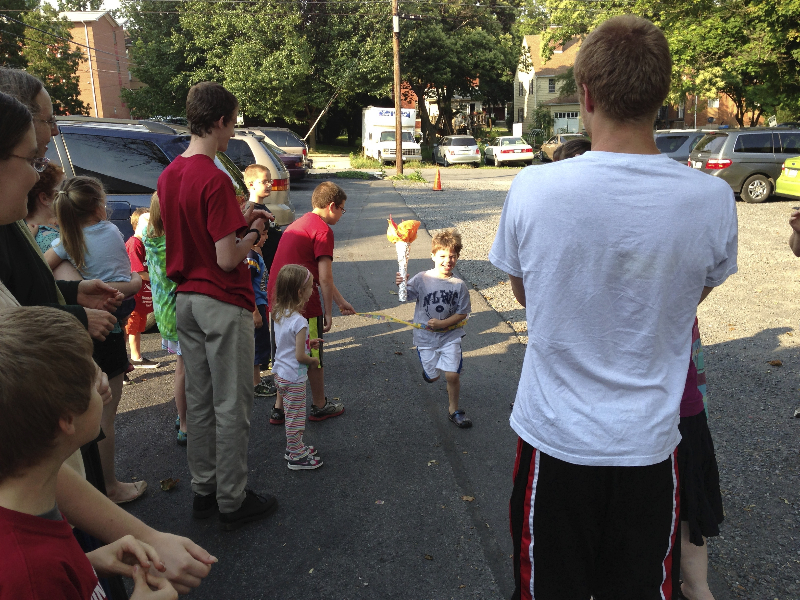
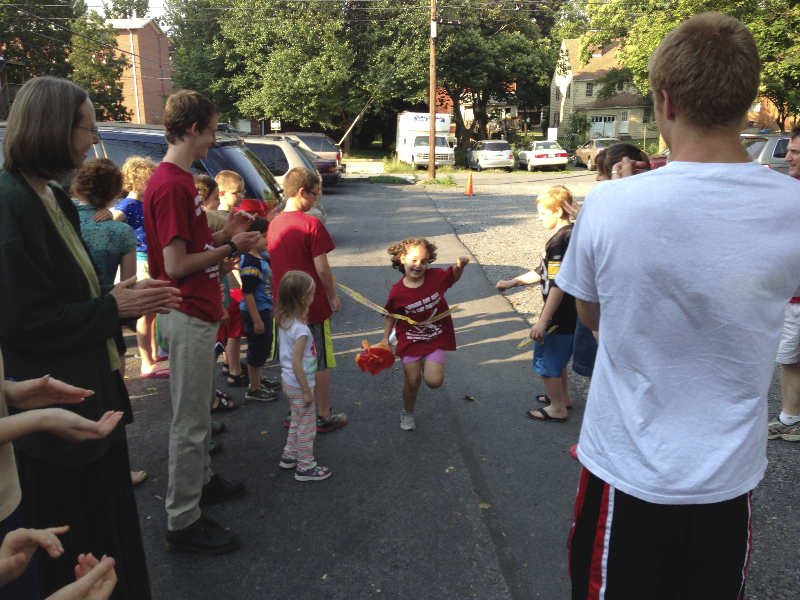
Two dozen children aged 3-12 enjoyed an exciting week of Vacation Bible School (VBS) last month, learning, understanding, and applying the vivid racing imagery of St. Paul that encourages us all to win imperishable crowns of righteousness.

Through dozens of activities, songs, and small group instruction conducted by a team of dedicated volunteers, students learned about the lifelong self-discipline necessary to reach the goal of continual spiritual growth in Christ.

Read Daily Recaps: Monday | Tuesday | Wednesday | Thursday | Friday
View Photographs on Facebook

Photo Gallery

Out of the Depths I Cry Unto Thee

June 14, 2012by Fr. Basil Biberdorf

At every vespers service we sing “Out of the depths have I cried unto Thee, O Lord; O Lord, hear my voice.” In the wake of the death we have witnessed recently, particularly the monster of a tornado last month in Moore, Oklahoma, words like these become the unutterable cry of the heart. It was an EF5 tornado, the strongest category with 200+ mph winds, and estimated at over one mile wide, which destroyed two elementary schools at dismissal time and wiped entire neighborhoods off the map. Parents and rescuers were left to search for children, other loved ones, and pets in the rubble, working against time, power outages, and road closures to save those whom they could. At the end of the confusion and chaos, the final death toll stood at 24, including 9 children.

What kind of God lets this happen? We could ask the same thing about the EF5 tornado that struck Moore previously in 1999, killing 40, or the EF5 that struck Joplin, Missouri, in May 2011, killing 162. Indeed, we ask the same thing about all manner of disasters of any origin. How can God allow this? Why doesn’t God do something?

The mystery for us is that God has done something. Fr. Thomas Hopko summarizes: “John Chrysostom has a sermon where people say, ‘Why doesn’t God do something?’ And he says, ‘What do you want Him to do?’ And then he went through this whole litany of everything that God does: He creates the world, we fall. He sends the prophets, He gives the Law. He gives the Commandments. Finally, he sends His own Son. Ultimately, he is crucified. What more is there? So when Jesus, hanging on the Cross, says, “It is fulfilled (tetelestai in Greek, sometimes translated, “It is finished”), it doesn’t simply mean it’s the end of the story. It means that it’s the total accomplishment of everything. Everything now is done. Nothing more can be done.”

The whole world—not just humanity, but the entire created order—was corrupted because of us. Before the Fall, there was no sin, and there was no death. Before the Fall, the destruction we witness from these disasters could not even be contemplated, for, without death, there is no true disaster. In the Fall, not only man is corrupted, but all of creation. “Therefore, just as through one man sin entered the world, and death through sin, and thus death spread to all men, because all sinned,” as St. Paul puts it in Romans 5:12. And, lest we condemn Adam, we must acknowledge that each of us would have sinned in the same way, insisting on our way rather than God’s, and the same destruction would be the result.

God has done something. He ascended the Cross. He partook of the death He did not create, suffering it as one for whom nothing could be more alien. He, too, cried out, “Why have You forsaken me?” with the groaning and anguish that went far deeper than ours could. He, too, cried from the depths. Life Himself entered into death in order to wage war against it, in order to liberate us from it.

Where is God in all of this? On the Cross, His arms open wide in the embrace of His beloved. Those who have reposed have entered into a death that is not permanent because of this embrace. “For as in Adam, all die, even so in Christ all shall be made alive” (1 Corinthians 15:22).

Editor’s Note: Fr. Basil wishes to acknowledge Chad Bird, who wrote an article that inspired this one. Fr. Thomas Hopko’s talk, “Word of the Cross” can be accessed here

Where Do We Go From Here?

DSCF2107 - Version 2by Fr. John Reeves

Last summer, parish ministry leaders pondered and prayed about options for our future growth. Specifically, they were as follows:

A. Do Nothing (in regard to Real Estate): Purchase no additional property but possibly add a second service to the Sunday schedule, i.e. an “early” liturgy in addition to the current format.

B. “Hive Off” Another Mission Congregation: Maintain HTOC as the “mother church” for a second mission to be planted in a new community about a half-hour’s drive from here (our first mission being the Chapel of the Holy Spirit).

C. Keep Our Sparks Location for a Ministry Center, but Relocate Worship to a New Site: The current location could be a student center or community outreach location.

D. Purchase Adjacent Property When It Becomes Available: Utilize adjoining facilities for offices, classrooms, and meeting space.

E. Relocate to New Site: Build a new, traditionally-designed church on a suitably located site.

Leaders analyzed each option, its strengths and weaknesses, as well as the opportunities and threats each might pose. This information was then evaluated by clergy staff for completeness: Were the right questions asked? Were the solutions proposed realistic and attainable? Did the option advance or hinder our mission?

Finally, this spring, Parish Council met in working session on May 18 to review the options and narrow the field for the church-at-large to begin to arrive at consensus over the coming months. The result of many months of deliberation, discussion, and debate was ultimately to present two options for parish consideration: Options “D” and “E”.

The other options were rejected in part because they either split the parish into two congregations—the early service congregation and the late service congregation, or the mission congregation and the “mother-church” congregation—or because of cost. (Option “C” was by far the most costly of the five.) These were not the only considerations, either for Options “D” and “E”, or against the first three.

The Council is to be commended for its willingness to sift through all the options and give the parish the benefit of its collective wisdom. Two things emerged during this process. Parish Council is united in wanting our parish to grow further, in obedience to the Great Commission; and Council believes strongly that our parish needs to remain “one in essence, and undivided.” (Where have we heard that before?)

Where does this leave us now? Over the summer, both options will be displayed on “response boards” in the Parish Hall. Everyone will have the opportunity to ask more questions and reflect honestly over what might be the best choice for our future. An informational meeting will be held early this fall, for open response and reflection. A parish vote could be held as early as the annual meeting in late autumn.

Vacation Bible School 2013:
Running the Race. Going the Distance.

VBS 2013

by Dn. Mark Oleynik

There are different ways that writers, songwriters, and poets tell the story of life. Some describe life as a tempestuous sea in need of a pilot. Others describe it like a battlefield full of danger and threat. Yet others describe life as a journey to be traveled.

But life is also a race. That is the way St. Paul looks at it in 1 Corinthians (9:24-27):

Do you not know that in a race all the runners compete, but only one receives the prize? So run that you may obtain it. Every athlete exercises self-control in all things. They do it to receive a perishable wreath, but we an imperishable. Well, I do not run aimlessly, I do not box as one beating the air; but I pommel my body and subdue it, lest after preaching to others I myself should be disqualified.”

A phrase from St. John’s gospel helps us to picture St. Paul’s race when he writes that Jesus, “enlightens every man that comes into the world” (1:9) When life begins, God lights the torch. It is ours to live and run, keeping the torch burning. It was said that the ancient torch race was a symbol of all life. This torch is inside: in the same place where the still small voice speaks, a flame is burning. That flame is the light of life. On the altar of the soul, there is a fire which must not go out. Keeping the inner fires burning is about the hardest task in life and St. Paul suggests some ways to do it.

Related: Daily Recaps from Vacation Bible School 2013


First, he says, “run that you may obtain it.” That is to say, get to the goal without letting anyone or anything else put out your light. Obtaining a worthwhile goal is attaining life. Rain and floods and wind come to extinguish the flame within the body’s temple where the Spirit dwells and must guard it.

Second, note that Paul also writes, “Every athlete exercises self-control in all things.” If the first goal is to get to the goal without letting anyone or anything else put out your light, the second appeal is to “get there” without putting out your own light.

A person who lacks self-control puts out his own light. For each light that is blown out by somebody else, there probably are many more which are put out by one’s own self. We are both our own best friends and worst enemies. What people say about us often hurts more than what they do against us, but the thing that hurts most is what we do against ourselves.

Related: See Pictures from Past Vacation Bible Schools


It is important to understand that the more intense one’s life and light, the stronger the temptation will be to burn it out quickly. The higher the ideals, the keener the conscience, the finer the soul, greater are the temptations. If you have much light, you need much control. To be set free by Christ means that one’s own light will never be put out. Rather it will see us through.

Finally, this passage encourages us to choose a worthwhile goal in life and move toward it; to really to keep our eyes on the goal. Losing sight of a worthwhile goal frequently causes us to take the short view of life, which makes pessimists and spreads the feeling of defeat. Our faith enables us to see the present (that’s the short view) as only a page in the large volume of life (that’s the long view). One page may be splattered with tragedies, defeats and heartbreak, but it is the whole volume that matters.

Register Now for VBS 2013.


To be a successful athlete it takes more than just showing up on game day or at race time. It takes preparation, discipline, sacrifice, smart choices, desire to win, and confidence. In St. Paul’s Corinth, a competitor trained and avoided all the things that might hurt his chance for victory. If he did this, he would win the prize of a pine wreath placed on his head—it was one of the greatest honors a Greek could receive. Likewise Christ wants us to endure, to fight to the end and beyond, to stand steady when all others have run for cover, and to hold aloft the banner of righteousness.

A Tale of Two Tough Weeks

by Fr. Lawrence Farley

“A tough week.”

This is how President Obama described the week of April 14—a week that saw acts of terrorism in Boston and a tragic fire and explosion in Texas compounding the other challenges with which life is often filled. Boston also experienced the emotional roller-coaster of lockdown, manhunt, shoot-out, and arrest. A tough week indeed.

These words, however, could also be used to describe another week, long ago, that also was filled with emotion, fear, and death. I refer, of course, to the last week of our Lord’s earthly life.

The week was filled with danger, since it was well known that Jesus’ foes had recently tried to stone Him, a fate which He narrowly escaped (John 11:8). For this reason, His entry into the city had to be secretly pre-arranged, as did the place in the city where He would eat the Passover meal (Mark 11:1f, 14:12f), for if He left the safety of the public crowds, He risked arrest and execution (Mark 14:1-2).

That Passover meal, eaten with the Twelve in secrecy, was marked by fear. He predicted that one of them would betray Him, that He would have to leave them, that they would all deny Him and leave Him alone. As they ate the bread at the beginning of the meal, and as they drank the cup of wine afterward, He declared the bread and wine to be His body and His blood, broken and poured out. They did not know what it all could mean, but they knew talk of death when they heard it.

Then came the catastrophic night of betrayal and arrest, when one of their own inner circle acted as guide to His enemies, and when they all forsook Him and fled. Peter, initially trying to prove himself brave, tagged along later at a distance, only to find himself denying Christ over and over again, as the Lord had predicted. While the disciples scattered and cowered, their Lord was being tried and mocked and beaten by His own people at an illegal all-night trial. When daybreak came, He was handed over to Pilate.

By three o’clock in the afternoon it was all over.

Jesus hung dead on the cross, beaten, disgraced, abandoned by almost all. His adversaries were triumphant. For them it was the most satisfying Passover in a long time. But not for the disciples of the Lord. For them, it was a tough week.

This review of the first Holy Week can help us through our own tough weeks, for it teaches us that God does not save us from fearful suffering and death, but reveals His salvation in the midst of it. The fear-suffused and dark Passover supper would be later revealed as the eternal and joyful Mystic Supper, as the meal of death became the meal of life. The moment of supreme defeat and disgrace on Golgotha would become the cosmic victory of God, when He worked salvation in the midst of the earth.

This shows that all our suffering can be transmuted into joy, if we wait on God. Dark days may tempt us, calling us to despair, to give up on God. Judas gave up: he took a rope and hanged himself. We must not give up.

Despair called to Peter too, for after he denied his Lord time and again, he went out and wept bitterly (Mark 14:72). But, in the end, he did not heed the call to despair. Despite his almost unbearable pain, he persevered, and waited and did not give up.

With God it is always worth the wait. Christ came to Peter and restored him, accepting his repentance and calling him to once again take up his apostolic calling and leadership. He came to all the disciples, forgiving them, gathering them, healing their hearts and breathing His Spirit into them.

Holy Week may have ended with the Cross on Friday and the Tomb on Saturday. But it gave way to the Resurrection on Sunday, the first day of the week and a sign of the timeless eighth day of eternity.

As we go through our lives and endure tough weeks, let us continue to wait on God. When day dawned that first Resurrection morn, all the pain of the past week faded with the passing darkness.

So it will prove for us.

Editor’s Note: Fr. Lawrence Farley is the priest in Langley, B.C., and is the author of many books and Ancient Faith Radio podcasts. This article originally appeared on oca.org.

From Holy Trinity to a Life Devoted to Service:
Where Are They Now?

Photo credit: Dn. Alexander CadmanPriest John Diamantis

Fr. John Diamantis (Psychology ’02) lives in New York City with his wife, Mka. Andrea, and their son Stavros, born November 2012. As Chairman of the Department of College Ministry for His Grace Bishop Michael, Fr. John ministers to students throughout the Diocese of New York and New Jersey, and also serves as a district chaplain for the same area with the North American Orthodox Christian Fellowship.

Currently, Fr. John is attached to Holy Trinity Orthodox Church in East Meadow, New York. There he is involved with a variety of ministries, both in the parish and in the New York City community, where he works to train and recruit foster parents. He expects to be officially assigned to St. Vladimir Orthodox Church in Trenton, New Jersey by Summer 2013 where he will be able to fully commit himself to the work of the Church.

Thinking back to his time at Holy Trinity and the Penn State Orthodox Christian Fellowship (OCF), St. John’s gospel, “He must increase, but I must decrease.” (3:30) encompasses the spirit of everything he learned and experienced here.

Photo credit: Facebook.comPriest Hector and Presbytera Katerina Firoglanis

Missions and church service always have been a part of the Firoglanis family. Shortly after leaving Penn State, Fr. Hector (Biobehavioral Health ’99) and Pres. Katerina (Art Education ’02), served together on a Summer 2002 mission trip to Kenya. Immediately after the Paschal Liturgy the following year, Fr. Hector proposed to Pres. Katerina and they were married four months later.

Fr. Hector attended Holy Cross School of Theology in Boston while Pres. Katerina taught at Theophany Preschool. After he graduated in 2004, Fr. Hector and Pres. Katerina studied Byzantine music and iconography, respectively, in Thessaloniki for a year before serving as long-term missionaries in Albania. After completing their term, Fr. Hector became the Assistant Priest of Annunciation Church in Lancaster, the same parish he and Pres. Katerina attended in their youth.

They now have three children, Christo, Evdoxia, and Vasili. Fr. Hector always thanks God for leading him to Holy Trinity where he discovered God’s calling during one of the most critical stages of his life.

Photo credit: Facebook.comPriest Gheevarghese John

Fr. Gheevarghese John (Marketing, ’02), graduated from St. Vladimir’s Seminary in 2002 and was ordained to the Holy Priesthood on March 26, 2011 at St. Thomas (Malankara Orthodox Syrian) Church, where he currently serves.

A prolific speaker and youth leader, and director of Way of the Cross Ministries, Fr. Gheevarghese is very active in campus ministry throughout the Philadelphia area, having been both the Secretary and Treasurer of the North American Mar Gregorios Orthodox Christian Student Movement (MGOCSM). Since 2005, he has taught Science and Math in the School District of Philadelphia.

Fr. Gheevarghese married Linju Jacob on July 5, 2009. They have a daughter together, Bethenny, born November 27, 2011.

HTOC  Trisagion 2013-04 (Krenitsky)Nun Helene (Krenitsky)

After diligently serving the St. Nicholas Church Choir (McKees Rocks, PA) Sister Helene (Mechanical Engineering, ’05) entered the Orthodox Monastery of the Transfiguration in Elwood City on July 26, 2009.

Using experience she gained while singing at St. Nicholas and Holy Trinity, she has taken on responsibility for the monastery choir for all chapel services. She is teaching the community how to breathe, blend, enunciate, and sing as a genuine choir.

Photo credit: Facebook.comDeacon Alexandros Petrides

For Dn. Alexey, his time in State College will forever be remembered as the place where his call to serve Christ was revealed. After his undergraduate studies (Civil Engineering/Water Resources, ’09), Dn. Alexey discerned a call to switch to “living water” (John 7:38) instead, and off to Holy Cross he went.

Now in his final semester at the Seminary, he is a husband (married to his wife, Stephanie, whom he met at a Penn State OCF retreat), a father (Niko, born on Pascha 2011), and was just ordained to the Holy Diaconate in January. Dn. Alexey and family will be returning to Pennsylvania after graduating in May to serve somewhere in the Greek Orthodox Metropolis of Pittsburgh.

With regards to the future, he looks forward to sending as many youth to Penn State as possible, to supply an ample Orthodox student population for the ministries of Holy Trinity and the Penn State Orthodox Christian Fellowship.

Photo Credit: Holy Assumption MonasteryNun Margarete (Roeber)

Sister Margarete (Liberal Arts, ’05) is now a member of Holy Assumption Monastery (OCA) in Calistoga, California. This monastery, the oldest for Orthodox women in the United States, was renovated over a period of twelve years, and Sister Margarete was part of an unexpected “transplant” of nuns to the property in 2009.

The community is still developing means of supporting itself, including mounting icons, baking, and producing fine chalice wine in conjunct-ion with a local Napa Valley Orthodox parish.

Photo credit: Facebook.comMissionary Maria Roeber

Maria Roeber (Nursing, ’04) is currently finishing a two-year term as an OCMC long-term medical missionary, providing health care to the people of Bukoba, Tanzania.

Although only spending a year-and-a-half at University Park (she was studying in Greece, Danville, or Hershey from the second semester of sophomore year until graduating), Holy Trinity and Penn State OCF  had a profound impact on her life. She fondly remembers going on an OCF trip to Holy Transfiguration Monastery with her sister (now) Sr. Margarete Roeber and (now) Sr. Helene Krenitsky.

They laughed at the time about the “alternative” choice of a student celebrating her 21st birthday at a monastery instead of at a bar, and it remains one of her favorite memories from her college years. Friendships formed at retreats, service projects, and Real Break Spring Break trips more than ten years ago have lasted to this day, and she continues to be so grateful to God for them.

Photo credit: Facebook.comPriest James Weremedic

Fr. James and Mka. Lisa attended Holy Trinity while he worked as the administrative director of radiology at Centre Community Hospital (now Mount Nittany Medical Center). After leaving Holy Trinity to pursue a life of church service, Fr. James graduated from St. Tikhon’s Seminary in 2001. Throughout his priesthood, Fr. James has been connected with campus ministry, serving as the OCF chaplain at Bloomsburg University while acting as rector of Holy Annunciation Church in Berwick.

In 2010, Fr. James and Mka. Lisa moved to Wilmington, home of the University of Delaware, to become rector of St. Michael’s Church. There he oversaw the completion of a half-million dollar Parish Hall construction project.

He and Mka. Lisa have been married for 27 years. They have 2 children, James Jr., who is now 23 years old, and a daughter, Victoria (age 15).

Lent: What Kind of Bore Will it Be?

DSCF2107 - Version 2by Fr. John Reeves

Many words can have more than one meaning. As I began to write this article the word “bore” came to mind, as in full bore. It’s a mechanical term referring to the maximum effort expended to get the most power out of a cylinder, or bore. Just as I was prepared to exhort everyone to put full effort into the remainder of the Fast, I thought of the other meaning of bore, as in to be bored! It made me think that for some, Lent might be approached more as a big bore, something to be endured, designed to take all the fun out of living and dining for forty days, and little else.

Let’s look at the two approaches. One presumes that there is indeed something to “get out” of Lent, that spiritual effort is required, but that in the end maximum benefits are the results. The Church certainly has this understanding. Manifold services are to be accompanied by fasting and additional personal prayer. It is a period which brings “great profit to the soul,” to quote from Lenten hymns.

The other approach, that Lent is a bore, views this time as the following rules and regulations, noting how strictly, or not, one fasts. Little emphasis is placed on prayer, the natural end of fasting. Therefore, attempting to fast can not only be a challenge but a “downer,” a meaningless exercise trying to stay on a semblance of an ecclesiastical diet, but nothing more. It becomes an end, in and of itself, and hence a spiritually insignificant practice.

april-24-2011Of course, the purpose of Orthodoxy is not to fast. It is to draw us into an ever closer relationship with God. During Lent, we have a dedicated, seasonal opportunity to do that, to be drawn ever closer to God by spending more time in prayer and worship and limiting the distractions of food and entertainment. The latter are not bad in and of themselves, but often become the focus of much of our lives.

The many opportunities for “extra” prayer and worship—Presanctified Liturgies, Memorial Saturdays, Mission Vespers—become a natural end of our fasting, if we are fasting to draw nearer to God. Without availing ourselves of them, without going “full bore”, however, limits Lent’s outcome, like underutilizing the potential power of an engine. We might fire on some cylinders, but not all. That’s when Lent becomes a big bore, something to endure at best, until “it’s over” at Pascha.

Clean Week was when we drained the crankcase and changed the oil at Forgiveness Vespers. Perhaps, we accompanied this by changing the timing on our spiritual engines. Or we might have adjusted our carburetors to accommodate a new spiritual regimen, a richer mixture of “fuel” and “air.” But unless we engage the disciplines of Lent fully, we are merely tinkering around in the garage, with an engine that might be idling nicely, but in a car that’s not going anywhere.

We don’t admire a car merely because it idles well, however. What we are really interested in is the ride. That takes more effort but it will demonstrate what the car was actually made for. Souls are like that, too. They aren’t made to idle, any more than cars are. Souls are made for action and movement. A Lenten discipline is a test track, a proving ground for the soul to reach its capacity.

For the rest of Lent, let the brake off and ease into drive. Don’t race the engine, but gradually increase the speed, the intensity of the spiritual effort. Lent won’t seem so boring, and we can make it to a fuller capacity, if not a wide open throttle, by Pascha.

Ultimately the biggest difference between “big bore” and “full bore” in Lent simply depends on the effort we put into it.

PHP Code Snippets Powered By : XYZScripts.com