Archive by Author

Orthodoxy 101 Returns This and Every First Wednesday

2012-09-11 19.42.32Do you want some basic knowledge about what Orthodox Christians believe? Orthodoxy 101 might be perfect for you. The class covers everything from:

  • developing of the Scriptures into the Bible,
  • the Church’s history,
  • the Eucharist,
  • Orthodox worship and developing a rule of prayer,
  • and much more.

Orthodoxy 101 classes take place on the first Wednesday of every month at 7 p.m. There will be refreshments provided for those interested in coming early and attending the 35-minute evening prayer service that precedes at 5:30 p.m. The class curriculum loosely follows Fr. Thomas Hopko’s The Orthodox Faith series, but each class takes on its own dimension based on the interests of those who attend. There are no prerequisites and newcomers can begin attending Orthodoxy 101 at any time.

Outside of first Wednesdays, Holy Trinity’s clergy are available to answer questions via email or meet with you one-on-one to discuss the Orthodox Faith.

To learn more about Orthodoxy 101, schedule an appointment, or ask a question about Orthodox Christianity, email us today at info@holytrinity-oca.org.

Sunday School Classes to Attend Instructed Proskomedia

On Sunday October 6, some Sunday School classes will observe (in the nave) the Liturgy of Preparation (proskomedia) during class time as part of their curriculum this year. This service (which is celebrated before every Divine Liturgy) is rarely seen except by the clergy. All are invited to attend with the students.

Clergy will take their entrance prayers and vest in the nave at approximately 9:10 a.m. The rest of the prothesis will continue in the nave as well.


Patriarch Tikhon Choir to Perform in Pittsburgh

The Patriarch Tikhon Choir, an American professional choir dedicated to the performance of Orthodox Christian sacred music, will perform at Pittsburgh’s First Baptist Church on Tuesday, September 17 at 7 p.m.

Conducted by renowned Moscow choirmaster Vladimir Gorbik, the program entitled “Their Sound Hath Gone Forth” will include works by Rachmaninov, Chesnokov, Kastalsky, Dinev, Trubachev, and Bortniansky, as well as more recent works by American Orthodox composers Kurt Sander, Nicholas Reeves, Nazo Zakkak, and Benedict Sheehan.

Tickets are only $15 and may be purchased online at patriarchtikhonchoir.com.

Study Group to Examine the Humanity of Christ

The Jesus We Missed Book CoverHoly Trinity’s Adult Study Group returns for second and fourth Tuesdays this Fall. Fr. John will lead an examination of The Jesus We Missed: The Surprising Truth About the Humanity of Christ by Fr. Patrick Henry Reardon.

The book offers insights into the humanity of Jesus Christ drawn from the Gospels so we can know God’s Son as He really is—a real man who came to redeem and sanctify every aspect of our lives. Participants will find the “historical Jesus,” not through biblical criticism but through the writings of the apostles  who knew Him best.

Intended for those already Orthodox but open to all adults, this bimonthly educational opportunity resumes on September 10 at 7 p.m. in the Parish Hall. Books will be available to purchase or to borrow.

Sabbatical Benefits Continue

by Fr. John Reeves

Fr. John poses with Mka. Linda at the Lewistown train station before departing on his four-month, 27,000-mile pilgrimage in 2010. His route retraced the late 18th-century journey that Orthodox missionary saints took from Finland to Alaska.

Fr. John poses with Mka. Linda at the Lewistown train station before departing on his four-month, 27,000-mile pilgrimage in 2010. His route retraced the late 18th-century journey that Orthodox missionary saints took from Finland to Alaska.

There are several benefits to a sabbatical: Some, such as rest and renewal for a pastor, are more immediate. Other benefits are residual. During my sabbatical three years ago, the parish was charged to develop a more self-reliant model of ministry in my absence. Administrative matters had to be dealt with in the absence of the priest and a working model of collaborative decision-making came into existence during that time.

In the ensuing time, this model has been maintained and expanded. Deacon Alexander Cadman now serves the parish as its full-time ministry coordinator, continuing to hone his skills which were greatly on demand while I had been away. The Parish Council continues to work together as a single unit, furthering our goals and looking forward to our future.

Such harmonious administration in the parish also means that when the priest now takes a vacation, things that need to be done don’t simply get put on hold until he returns. Lay leadership has taken stock of its own responsibilities and continues to press ahead.

Consequently, after three weeks in my Texas homeland—a time spent visiting families, attending reunions, co-officiating at a wedding for a former student in Houston (Jab Tannous), and capped off by a visit to New Orleans en route home (an homage to Matushka’s Cuban and French ancestry)—I could return without dreading a mound of unfinished work or unattended situations.

I could come back, rested and renewed a bit knowing that Vacation Bible School would be wrapping up another successful summer thanks to Deacon Mark and those that volunteered; that we would soon celebrate our parish feast of Pentecost together and go picnic in the park afterwards; and that we could then have the double joy of David Smith’s ordination on the Feast of Ss. Peter and Paul and the wedding of Paul Petrogeorge and Larissa Moser the next day.

In other words, I stopped working during vacation. I rested though it sounds like I was very busy. In short, I relaxed. But the parish did not slow down a bit. That’s a great stress reliever, an ongoing benefit of that sabbatical three years ago which keeps paying dividends even now.

Related: Peruse In the Footsteps of St. Herman, Fr. John’s Sabbatical Blog


Chapel of the Holy Spirit: Why Koinonia?

by Fr. Basil Biberdorf

And they continued in the apostles’ doctrine and fellowship, in the breaking of bread, and in prayers… So continuing daily with one accord in the temple, and breaking bread from house to house, they ate their food with gladness and simplicity of heart, praising God and having favor with all the people. (Acts 2:42, 46-47)

Chapel of the Holy SpiritThis is how Luke describes the earliest Christian gatherings, as described to him by the people who actually attended them. The earliest Christians still self-identified as Jews. As a result, they regularly attended services at the Temple in Jerusalem, thereafter adjourning to private homes of the followers of Christ, perhaps in rotation based on “from house to house,” in order to partake of Christ’s Body and Blood in the Eucharist (breaking of bread) celebrated there according to a specific order of service (“the prayers”). Thus, the earliest Christian communities were defined by their practice of Holy Communion performed according to a specific liturgical rite.

However, this gathering didn’t really end there, because there was a further eating of “their food with gladness and simplicity of heart.” In other words, the meal did not end with the Body and Blood, but progressed to the physical food needed by the created bodies of the men and women gathering together. It was for koinonia (Greek for communion, pronounced “kih-noh-NEE-ah”) not only with Christ but with each other. It was already a service for the wealthier members of the community to offer their homes for the celebration of the Eucharist, as not many people had “homes” with rooms such as could accommodate a gathering. It was also the opportunity for the group to care for the poorer members, particularly widows and orphans, by providing them a much-needed meal.

Just as importantly, these gatherings punctured the walls separating the social classes of the Roman world. The eating of a meal was intimate. Those dining came together in close quarters, and hosts didn’t dine with just anyone. (Consider the indignation of Christ’s enemies in Luke 15:2 and Mark 2:16.) This meal was different. The rich host not only gave food to the poor, but invited them into the home, along with the merchants (which were not terribly respected), butchers, weavers, and other believers. They came together not in some kind of Christian “commune,” but because they were “in one body,” in recognition of their humanity regardless of whether they were slaves or free men, Jews or not (1 Cor. 12:12-13).

This was a time to be together regardless of the way of life each of them experienced in other times. Indeed, without such a gathering, how would any of them have any perspective on the lives as lived by their Christian brethren? We know it is true for us in our own time as well.

In short, the koinonia of those first century believers was nothing but the expression of what it meant to be Christians. Which brings us to our current situation, where, following the Divine Liturgy, we are often rather focused on returning to our daily activities, even on Sunday. In so doing, we often break the fullness of our koinonia too quickly.

Those of us familiar with our Chapel practice are aware of the potluck meal that follows our Sunday gatherings. Some may even find it odd, wondering, “You do that every Sunday?” Well, yes, and it is a highlight for most who come. It is an opportunity to sit down for a few minutes to break more bread and to rejoice in the “horizontal” communion we have with each other, having received the “vertical” Communion that comes from Christ. It is an opportunity to hear of the joys and sorrows of our brothers and sisters in Christ. We can hear news directly, without risk of gossip.

Each of you is encouraged to pray with us at the Chapel, and to join us afterward for our meal. I also extend a special invitation to you to join us on July 7 for our annual “Close to Independence Day” gathering. After the Divine Liturgy that Sunday, we will be going to the Tall Timbers natural area near Troxelville (from State Route 235, take Timber Road and Swift Run Roads into the park), for a nice afternoon among trees and streams, and with plenty of food and fellowship. We are also organizing a short hike this year. It’s cool under the trees, even on a hot day.

Bring a change of attire, plus shoes for hiking (if you want to join in), and “getting wet clothes” (including water shoes or flip-flops) for wading. Bring some folding chairs, too, as you’ll want to sit, relax, and enjoy the summer afternoon.

Students Sprint to the Finish of a Week Full of Learning, Fun

Two dozen children aged 3-12 enjoyed an exciting week of Vacation Bible School (VBS) last month, learning, understanding, and applying the vivid racing imagery of St. Paul that encourages us all to win imperishable crowns of righteousness.

Through dozens of activities, songs, and small group instruction conducted by a team of dedicated volunteers, students learned about the lifelong self-discipline necessary to reach the goal of continual spiritual growth in Christ.

Read Daily Recaps: Monday | Tuesday | Wednesday | Thursday | Friday
View Photographs on Facebook

Photo Gallery

VBS 2013 Daily News: Friday

“And Run and Run and Run and Run and Run”
VBS kids ask the Lord to help them to hold on until they get their crowns!

IMG_3595State College, PA – On the longest day of the year, Holy Trinity’s Vacation Bible School concluded with the students more keenly aware that their Christian race may also be long and it must be run every day and with every decision. Today’s learning objective was that each person is given a gift – it is our responsibilitly to use that gift to the glory of God.

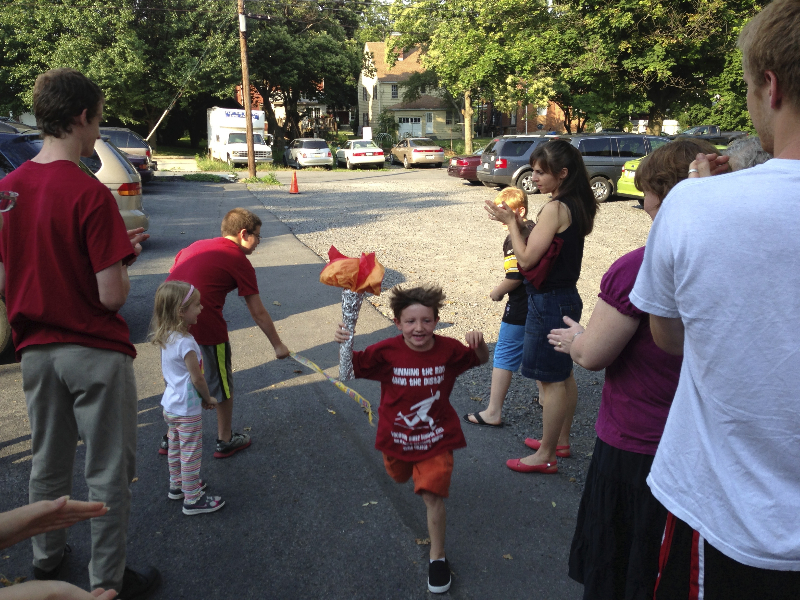
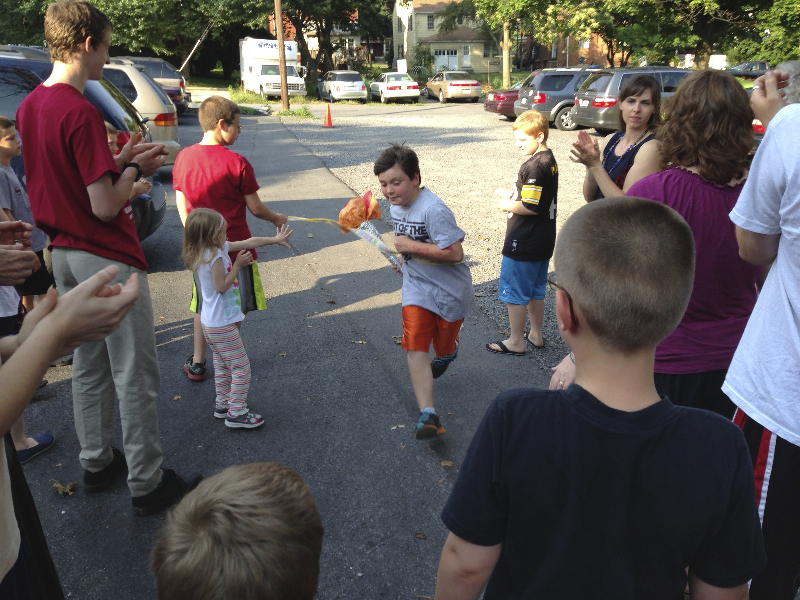
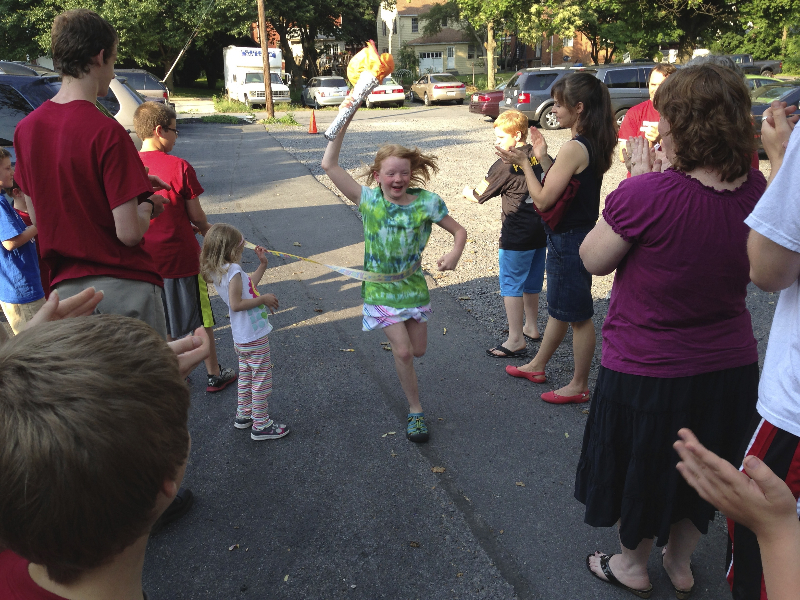
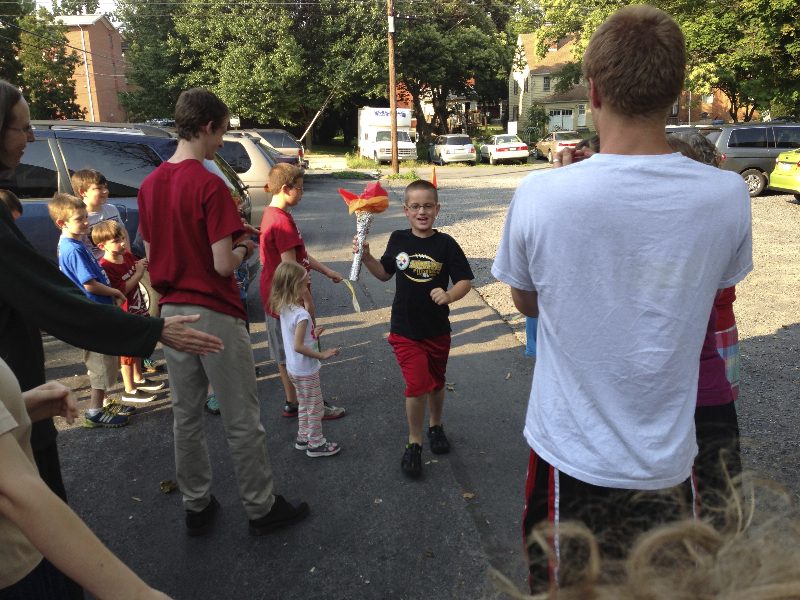
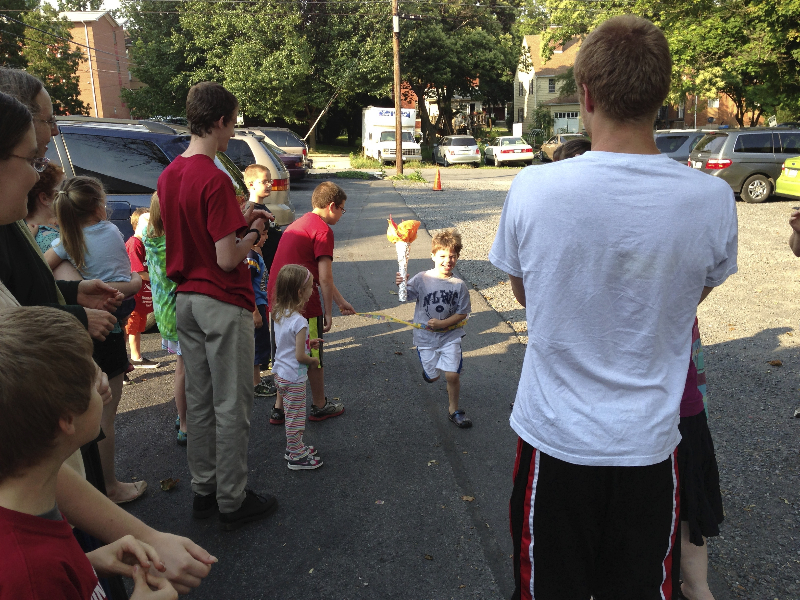
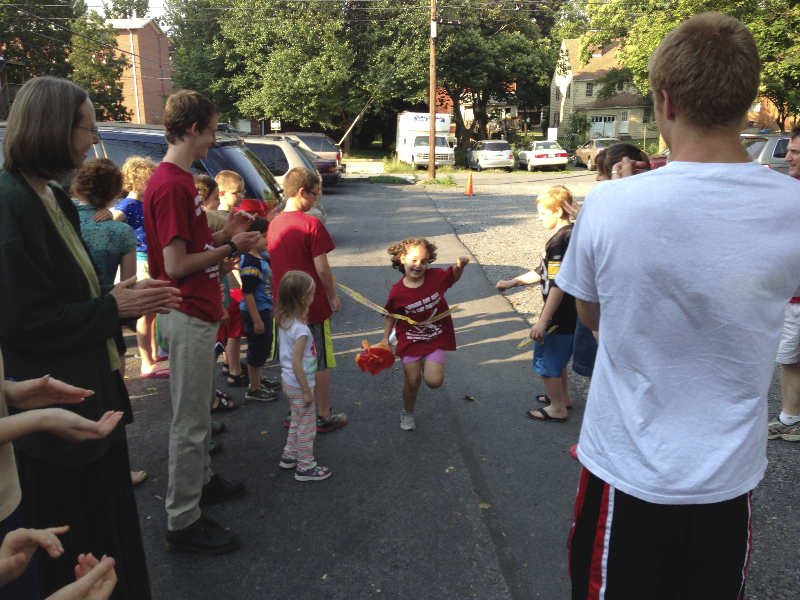
To kick off the final day and in the Olympic-like fashion, students carried a torch in relay in the neighborhood to the surprise of local residents. However, unlike the ancient Olympic fire which commemorated the theft of fire from the Greek god Zeus by Prometheus, the VBS kids were encouraged to be torchbearers for Christ while they run their race.

What’s in the Book?

IMG_3592

“I fought the good fight, I have finished the race, I have kept the faith. Now there is on store for me the crown of righteousness, which the Lord, the righteous Judge, will award to me on that day— and not only to me, but to all who have longed for his appearing.”  (II Timothy 4:7-8)

Paul is at the end of his life looking back. In doing so, he realizes that Christianity is a struggle, but he has fought well. He realizes that Christianity is a race, but he ran to the finish. He didn’t give up along the way. He realizes that Christianity is a life of faith—faith that he kept. He didn’t lose his trust in God. Finally, he realizes that he will be rewarded for the way he lived his life.

  • Christianity is a struggle, but I must fight.
  • Christianity is a race, and I must keep running.
  • Christianity is a life of faith, and I must trust God.
  • In doing these things, God will reward me.

The greatest reward is what someone becomes through the effort. The greatest reward is becoming all God created someone to be in his/her relationship with Him.

IMG_3594Thoughts to Keep You Running!

  • “Only one person and one person only will determine how good of a runner you become. You will become as good as you let yourself be. That one person is you.”
  • “Running – it isn’t easy but it’s worth it.”
  • “There will come a point in the race, when you alone will need to decide. You will need to make a choice. DO YOU REALLY WANT IT. You will need to decide.
  • “We are designed to run, and we increase our chance of daily happiness when we do so.”
  • “Do not fear going forward slowly; fear only to stand still.”
  • “There’s no better day to start running than TODAY.”
  • “It’s not about how fast you run but where you’re going.”
  • “Endurance is patience concentrated.”
  • “If you’re too busy to run, then you’re too busy.”
  • “To give anything less than your best is to sacrifice the gift.”
  • “If the word quit is part of your vocabulary, then the word finish is likely not.”
  • “Never stop running.”
  • “Running sets me free.”
  • “Every day is a new chance to run.”
  • “Ask yourself: ‘Can I give more?’ The answer is usually: ‘Yes’.”
  • “Winners never quit, and quitters never win.”
  • “Now… Just run.”


VBS 2013 Daily News: Thursday

Christian Goal Setting: Students Learn About Keeping Their Eye On the Prize!

IMG_3553State College, PA – Would you set out on a journey is you didn’t know the destination? That’s the question that Holy Trinity VBS students explored today as they discussed what it means for the Christians to set a goal and to focus on it. It is important that each of us discover God’s course or plan for us. There will be challenges, the struggle will be tough, but the rewards will outweigh anything we can imagine.

Christians are heartbroken and pulled in all directions by the overwhelming sense of need in the world. It is impossible for one individual to meet all these needs, nor can he or she expect to do so. In order to be the most effective, we can not spread ourselves out going in all directions, any more than a cross-country runner can run down all  roads. We can not just throw up our hands and do nothing either; ultimately we would get nowhere.

“Do you not know that in a race all the runners run, but only one gets the prize…therefore I do not run like a man running aimlessly: I do not fight like a man beating the air.” (1 Cor. 9:24, 26).

IMG_3548Can you imagine a football coach telling his football coach to individually run where to go: What chaos would result? Would they achieve anything? But if each player does his part towards a purpose, a goal is often achieved. We need to do the same with the individual activities in our lives. We need to focus on things we do toward the goal God has for us.

Doing What It Takes to Reach the Goal: Self-Discipline

What is self-discipline?

  1. Discipline must be complete. Training some muscles and neglecting others does not help. Running well the first half of the race and taking it easy the second half will not help you to win.
  2. Discipline must be consistent. Growth is very slow, but decay is very quick. It takes months for a tomato to develop and ripen but it can rotten in a matter of days.
  3. IMG_3526Discipline must be a personal choice. We must count the cost of following Christ. We will never be fully disciplined in our walk until we understand what it really cost us, and what it cost Christ. Until the decision to follow Christ is completely ours, for our own reasons, we will never be disciplined enough to stick to it. Make up your mind what you will do with your life.
  4. Discipline must be a commitment. If we are going to win, we must really want to win! Those who have never taken hold of the prize with their hearts will never take hold of the prize with their hands. We must live our Christian lives because we want to, not because everyone else is doing it.

VBS Curriculum Acknowledgement

This year’s classroom instructional and VBS Daily News content is based upon the “Creative Youth Ideas” study series Destined to Win by Ken Sapp.

VBS 2013 Daily News: Wednesday

PRESSING FORWARD: Students Vow to Keep Going and Growing in Christ

State College, PA – Sometimes it’s easy to just give up when things aren’t going well and students at Holy Trinity’s Vacation Bible School learned how to resist the urge to quit. The topics of discussion were varied and enthusiastic as students discovered that:

  • IMG_3532Pressing forward implies that there will be resistance.
  • If you are not pressing forward, you are falling behind.
  • Pressing forward is progress, not just motion.
  • The effort of pressing forward produces growth.

With this new found knowledge, the students are learning to understand that there will be challenges and obtacles to overcome and be prepared to take them on.

What’s in the Book?

“Not that I have already obtained all this, or have already been made perfect, but I press on to take hold of that for which Christ Jesus took hold of me. Brothers, I do not consider myself yet to IMG_3534have taken hold of it. But one thing I do: forgetting what is behind and straining toward what is ahead. I press on towards the goal to win the prize for which God has called me heavenward in Christ Jesus…. Join with others in following my example, brothers, and take note of the pattern of those who live according to the pattern we gave you. For as I have often told you before and now say again, even with tears, many live as enemies of the cross of Christ. Their destiny is destruction, their God is their stomach, and their glory is in their shame. Their mind is on earthly things. But our citizenship is in heaven. And we eagerly await a Savior from there, the Lord Jesus Christ, who by the power that enables him to bring everything under his control, will transform our lowly bodies so that they will be like his glorious body.”  (Philippians 3:12-14, 17-21)

IMG_3536In a Greek race, the wreath was placed upon the finish line so that all the runners could see it. It was an incentive for the runners to give their best. It was something upon which they could focus their concentration. The picture Paul paints for us is one of a runner, with his body bent forward, reaching out toward the goal, with his eyes fixed upon the prize. It is not just looking ahead, it is reaching ahead. Paul realizes that he has not yet crossed the finish line himself. He cannot sit back and relax. Paul urges us not to forsake the progress we have made thus far and to continue to press forward.

FPO – For Parents Only

VBS Daily News is prepared especially for YOU.  In each issue, you will read about the major topics discussed and the learning objectives for each day.  Take time to read it (particularly the scriptural references) and discuss it with your child.  Hopefully, they will be able to describe to you the race we are to run as Christ’s followers.


PHP Code Snippets Powered By : XYZScripts.com